
The market faced an unusual situation.
At the next Fed meeting, investors no longer expect aggressive tightening. But at the same time, medium-term expectations remain quite tight.
It is this contradiction that is now becoming the main issue for betting.
Why Goldman Sachs is not waiting for a promotion
Chief Economist of Goldman Sachs Jan Hatzius considers raising the rate at the meetingSeptember 15–16unlikely.
The reason is simple: the latest data does not give the Fed enough reason to hurry.
In July, employment growth was weak, retail sales fell by 0.6%, and inflation continued to slow. PPI also declined year-on-year from 5.5% to 4.7%.
This is an important combination for a central bank.
The economy is cooling and price pressures are not intensifying.
This means that the need to urgently raise the rate is becoming less.
But Kalshi looks further
Forecast markets give a completely different signal.
Kalshi is now assessing the likelihood of the next rate hike:
until 2027 — about 51%;
until July 2027 — about 68%;
74% by 2028.
That is, the market practically eliminates the need for an immediate increase, but considers it quite likely that the Fed will still have to tighten policy later.
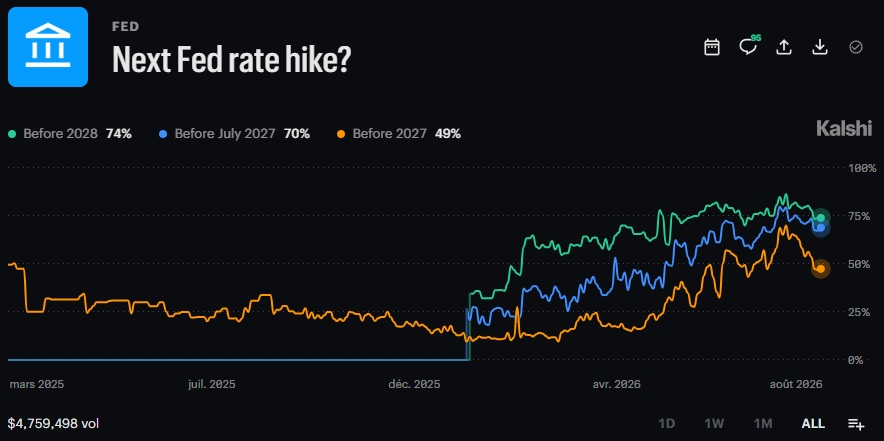
The probability of the next Fed rate hike according to the Kalshi forecast market. As of August 2026, the probability of an increase until 2027 is about 49%, until July 2027 — 70%, and until 2028 — 74%.
And here arises the main paradox.
Pause does not mean the end of tightening
The Fed can leave the rate unchanged in September, wait for new data and only then make a decision.
If inflation accelerates again and the economy turns out to be more resilient than expected, the rise will return to the agenda.
Therefore, today's market rate looks like this:
september is rather a pause;
2027 — the risk of a new increase remains.
What this means for markets
If Goldman Sachs proves to be right, short-term pressures on stocks and bonds could ease.
But if Kalshi turns out to be right about the medium-term outlook, the market will have to take into account the higher cost of money for a long time to come.
For a trader, therefore, not only the Fed rate itself is important.
Much more importanttrajectory of expectations.
If inflation continues to decline, the likelihood of an increase will go further.
If prices accelerate again, the market will quickly begin to return the increase to quotes.
Main conclusion
Now the market actually separates the two scenarios.
A September hike looks unlikely.
Butthe end of the tightening cycle is not yet guaranteed.
Goldman Sachs is betting on a pause, while Kalshi shows that market participants still see a high probability of an increase in the longer term.
It is this discrepancy that can become one of the main sources of volatility in the betting market in the coming months.