
Norway has created one of the most unusual investment mechanisms in the world.
The country did not just spend oil and gas revenues.
It has turned them into a global portfolio worth about$2.3 trillion.
Today, this fund owns stakes in about7,100 public companiesand on average controls about1.5% of all listed companies in the world.
That is why its results are interesting not only for Norway.
When such an investor earns $184 billion in six months, this is actually a large-scale indicator ofwhat happened to global capital markets.
And in 2026, the answer was pretty obvious:
technology and artificial intelligence have once again become the main engine of growth.
$184 billion profit for six months
In the first six months of 2026, the Government Pension Fund Global generated returns9,4%.
In monetary terms, this was approximatelyNOK 1.75 trillion, or $184.3 billion.
This is the best result of the fund for the first half of the year in history.
But something even more interesting happened inside those six months.
The first quarter was weak.
The fund lost1,9%, and it was the fall of the largest American technology companies that became the main factor in the negative result.
And then the situation turned around.
In the second quarter, the fund earned immediately11,5%.
For such a gigantic portfolio, this is a colossal movement.
And it was the second quarter that actually turned the unsuccessful start of the year into a record first half of the year.
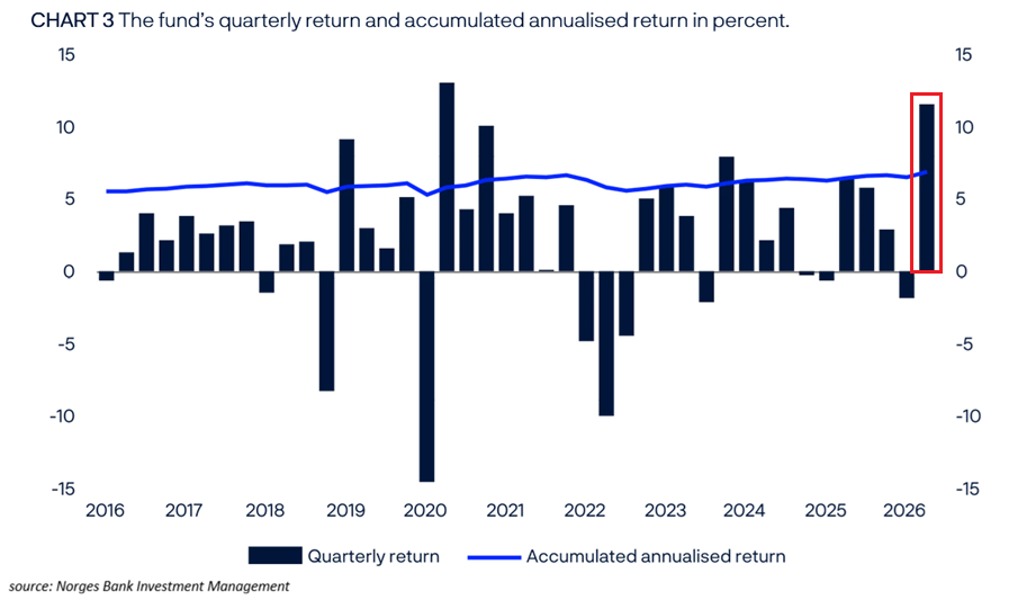
Government Pension Fund Global quarterly return and accrued annual return. In the second quarter of 2026, the fund received 11.5% after a 1.9% decline in the first quarter. Source: Norges Bank Investment Management.
The main engine was where it was expected to be
The answer was stocks.
In the second quarter, the fund's stock yield was about16%.
They provided most of the result.
The technology segment was particularly strong, and not only American giants, but also Asian companies associated with the production of chips and AI infrastructure played an important role.
This is an important detail.
The history of artificial intelligence is no longer limited to Nvidia or a few US companies.
It is distributed throughout the chain:
→ memory chips → equipment → data centers → cloud services → software → AI products.
Therefore, the investment effect of AI is becoming global.
Nvidia, Microsoft and Apple are already inside the portfolio
The Norwegian fund is not trying to guess one “next Nvidia”.
His strategy is much broader.
But this does not prevent the largest technology companies from occupying a huge weight in the portfolio.
Among the largest positions areNvidia, Apple, Alphabet, Microsoft and Taiwan SemiconductorAt the same time, about 20% of the value of the entire fund already accounts for its ten largest investments.
And here comes an interesting paradox.
The fund is considered one of the most diversified investors in the world.
But the growth of the largest technology companies is so massive that even such a giant is gradually becoming dependent on their results.
AI brings not only profitability, but also the risk of concentration
At first glance, everything looks perfect.
AI is growing.
Chips are getting more expensive.
The profits of technology companies are increasing.
The fund earns tens of billions.
But the stronger the technology sector grows, the greater its weight in global indices.
And the more weight, the stronger any change in expectations affects the entire market.
This is exactly what the head of Norges Bank Investment Management, Nikolai Tangen, has already noticed.
He warned about the growing concentration of the portfolio and noted that about a fifth of the fund's value now falls on the ten largest positions.
That is, the problem may look paradoxical:
there is diversification, but the market itself is becoming less diversified.
Why was the second quarter so strong?
After a weak start to 2026, investors again began to actively buy technological assets.
At the same time, Asian markets, especially semiconductor-related companies, recovered.
For the Norwegian Fund, this is especially important because of its huge global scale.
If the US market grows, the fund gets an effect.
If Japan grows, the fund gets an effect.
If Taiwan or South Korea grows, the fund gets the effect again.
And that is why the result of the fund can be considered as a kind ofbarometer of the global investment cycle.
But there is one number that cannot be ignored
The Fund manages approximately$2.3 trillion.
At the same time, its average share in global public companies is about1,5%.
This means that Norway is actually one of the largest indirect participants in the global stock market.
When such volumes of capital begin to move along with a certain trend, this is no longer just the story of one investor.
This is part of the global demand structure.
And now a significant part of this demand is related to technology.
But the Norwegian Foundation doesn't just “bet on AI”
This is important to understand.
The fund is not a technology hedge fund.
Its strategy is based on global diversification and long-term investment.
Therefore, the growth of Nvidia, Microsoft or Apple is not the result of managers trying to guess the next winner.
Much of the technology exposure arises naturally through global indices and the scale of the largest companies.
And that is why the success of the fund is simultaneouslybullish signal for technology and warning of market concentration.
What happens if the AI cycle slows down?
This is where the real intrigue begins.
As investment in AI continues to grow, companies produce more chips, build new data centers and increase computing power, the technology sector can continue to support the entire market.
But if the pace of capital spending begins to slow down, the situation will change.
Then investors will start asking other questions:
Are current estimates justified?
When will AI investments start delivering the expected return?
Isn't too much capital diverted to one technology topic?
This is especially important for the Norwegian Fund because of its scale.
Even a small movement of the largest positions can change the result by tens of billions of dollars.
Interestingly, the year started very differently
In the first quarter, the fund lost1,9%.
The drop in shares was2,6%, and the value of the fund decreased by about 1.27 trillion kroner. The main reason was the weak results of large American technology companies.
And just a few months later, the fund got the best quarterly result since 2020.
This is a great illustration of how fast the modern market is changing.
Yesterday, investors were afraid of a correction in technology stocks.
Today, the same companies are again becoming the main source of profit.
What does this mean for the investor?
The history of the Norwegian Foundation shows two things at the same time.
First —The AI cycle is really creating tremendous value.
Second —more and more of this value is concentrated in a relatively small number of companies.
As long as profits and capital expenditures continue to rise, it works for the investor.
But if expectations start to change, the effect could be reversed.
Therefore, now it is important to look not only at how much Nvidia, Microsoft or Apple earned.
It is much more important to keep an eye onaccelerates or slows down the entire investment cycle around artificial intelligence.
Main conclusion
The Norwegian Petroleum Fund has earned$184.3 billion for the first half of 2026and the second quarter brought him11.5% yield.
This is an impressive result.
But even more interestingly,where did this profit come from.
The main driver was stocks, and within them, AI and semiconductor-related technologies and companies were particularly strong.
It turns out to be a symbolic picture.
Norway has made its fortune on oil.
Now its largest investment asset is earning record amounts on technology.
But along with the profit, the dependence on the new global market engine is also growing.
And the main question is no longer whether artificial intelligence can enrich investors.
He's already doing it.
The question is different:
how much more profit will the market be able to extract from the AI boom before expectations begin to grow faster than real results?
What does this mean for the market?
The results of the Norwegian Fund confirm the strength of the current technological cycle, but at the same time show its vulnerability.
If AI investment, chip demand and corporate profits continue to rise, the biggest tech companies could continue to support global indices.
If the growth rate begins to slow down, the high concentration of capital in technology giants can strengthen the correction.
Therefore, three indicators are especially important for the investor now:
AI-capex of the largest technology companies
profit dynamics of chip manufacturers
the width of the stock market outside the largest technology companies
They will show whether the current boom is a sustainable investment cycle or whether the market is already starting to depend too much on one topic.